Intake to demand,worked by a fleet you supervise.
Justine decomposes the matter and dispatches it — intake, medical chronology, valuation, strategy, deposition prep. Each finding is traced to a page in the record. Every authority is verified before it reaches a document. You read the defense’s argument before you are in the room with it, and nothing leaves the building without you.
14 days free · no credit card · self-serve signup
Watch Justine work a file →Read the full capability catalogue →
The personal-injury file, worked end to end.
The product screens in this film are a synthetic demonstration matter. No client information. Any figures shown are outputs of that demo matter, not customer results.
You read the other side’s argument before you are in the room with it.
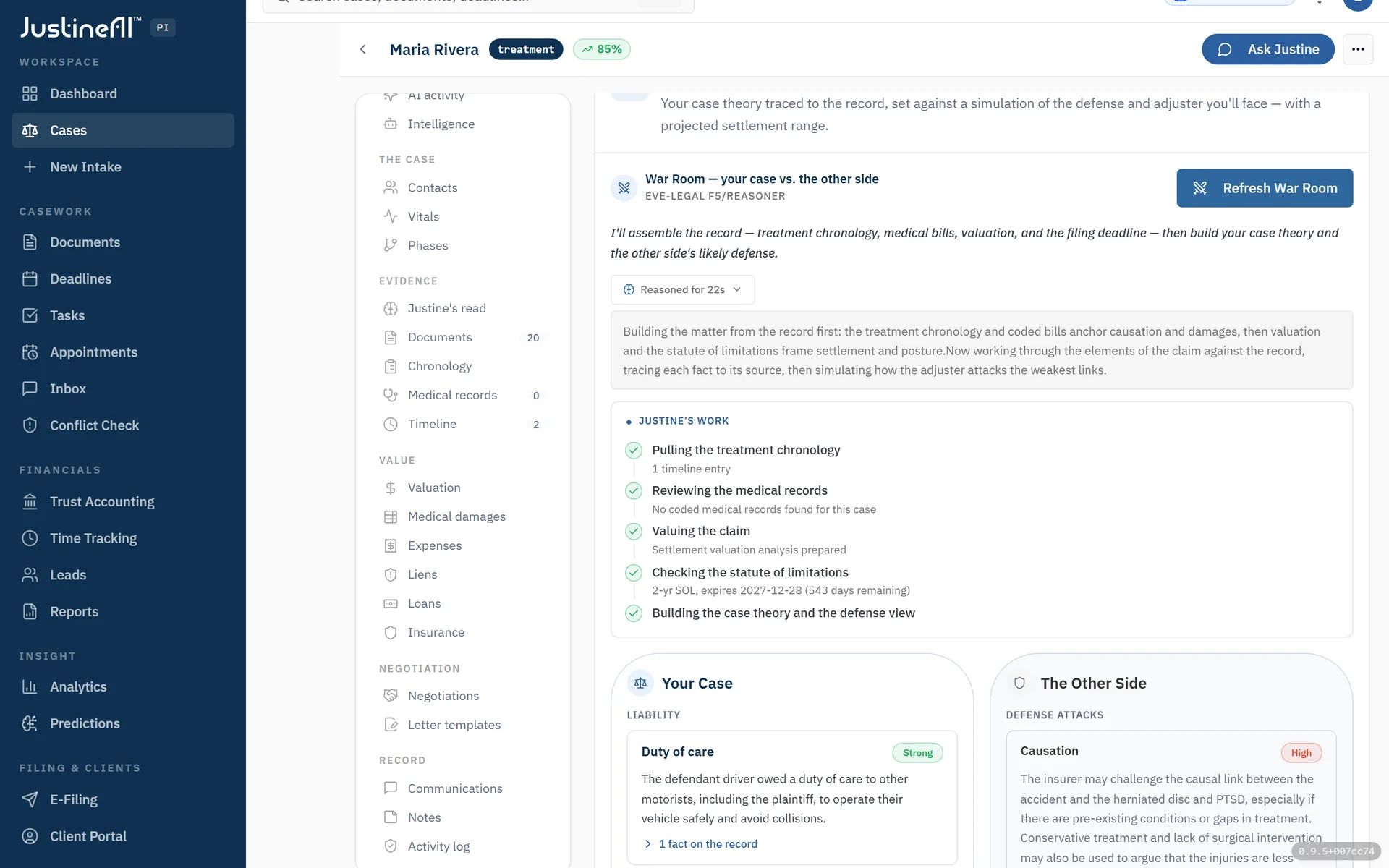
Captured from the working product on a synthetic demonstration matter (SAMPLE_PI_001). No client information. Figures shown are outputs of that demo matter, not customer results.
Four things you can go and verify.
The citation check fails closed.
Every authority is verified against CourtListener before it reaches a document. One that cannot be verified stops the work product and says so by name, rather than quietly softening into a footnote.
The draft is stress-tested before you see it.
A demand composes through four passes — validation of the damages arithmetic and chronology, a senior-attorney strategic review, targeted auto-revision, and a red team playing the defense adjuster.
Every finding is traced to the record.
Not a summary you have to trust. Each extracted value carries the source document and page, and a validator council surfaces cross-source conflicts for you to resolve before anything is assembled.
Where Justine refuses is written down.
What she will not do on a PI matter, and why. An agent that declines to guess a statute-of-limitations date is worth more than one that will.
Every letter survives the other side before it reaches you.
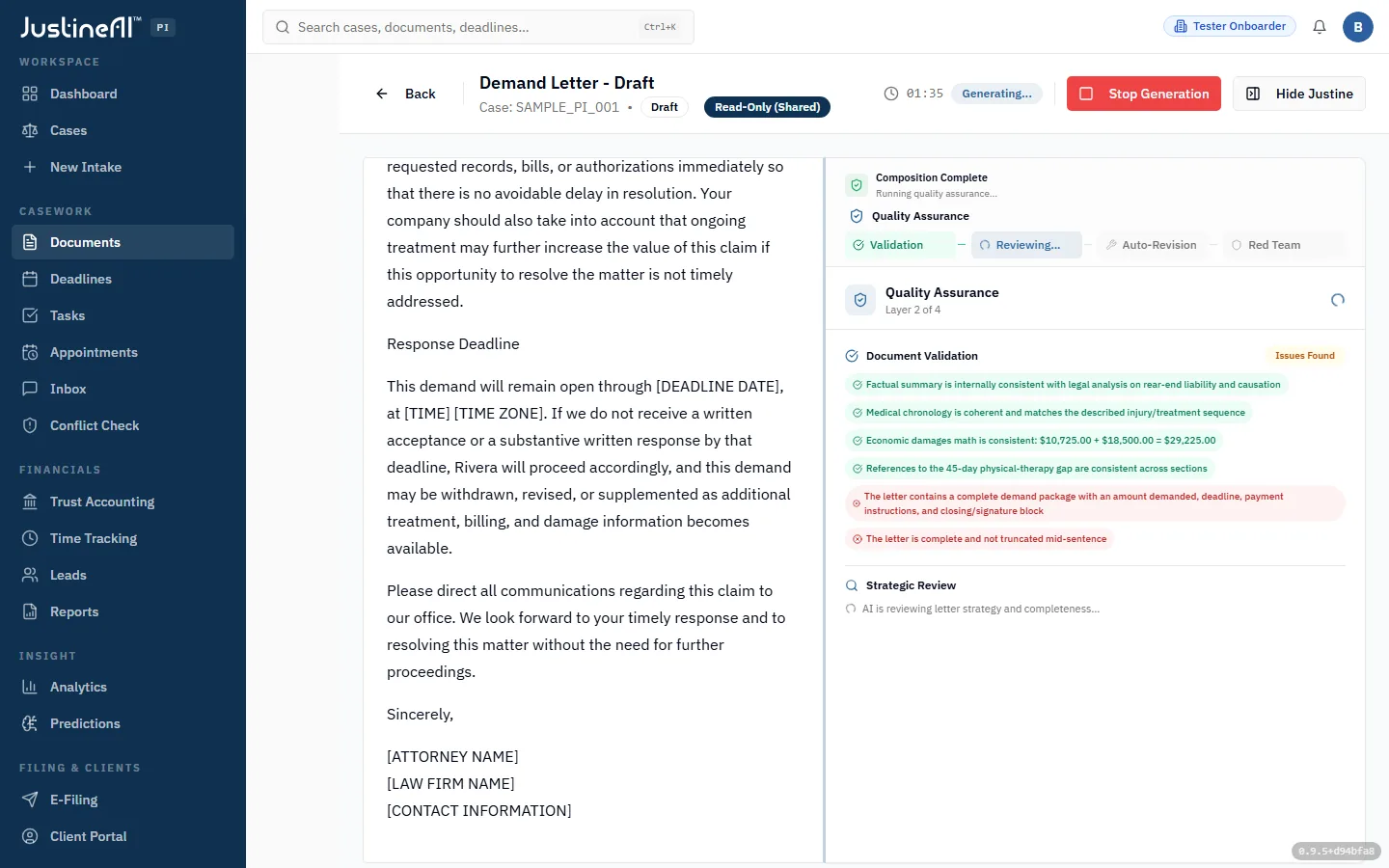
Captured from the working product on a synthetic demonstration matter (SAMPLE_PI_001). No client information. Figures shown are outputs of that demo matter, not customer results.
A number you can defend to the carrier and to the partner.
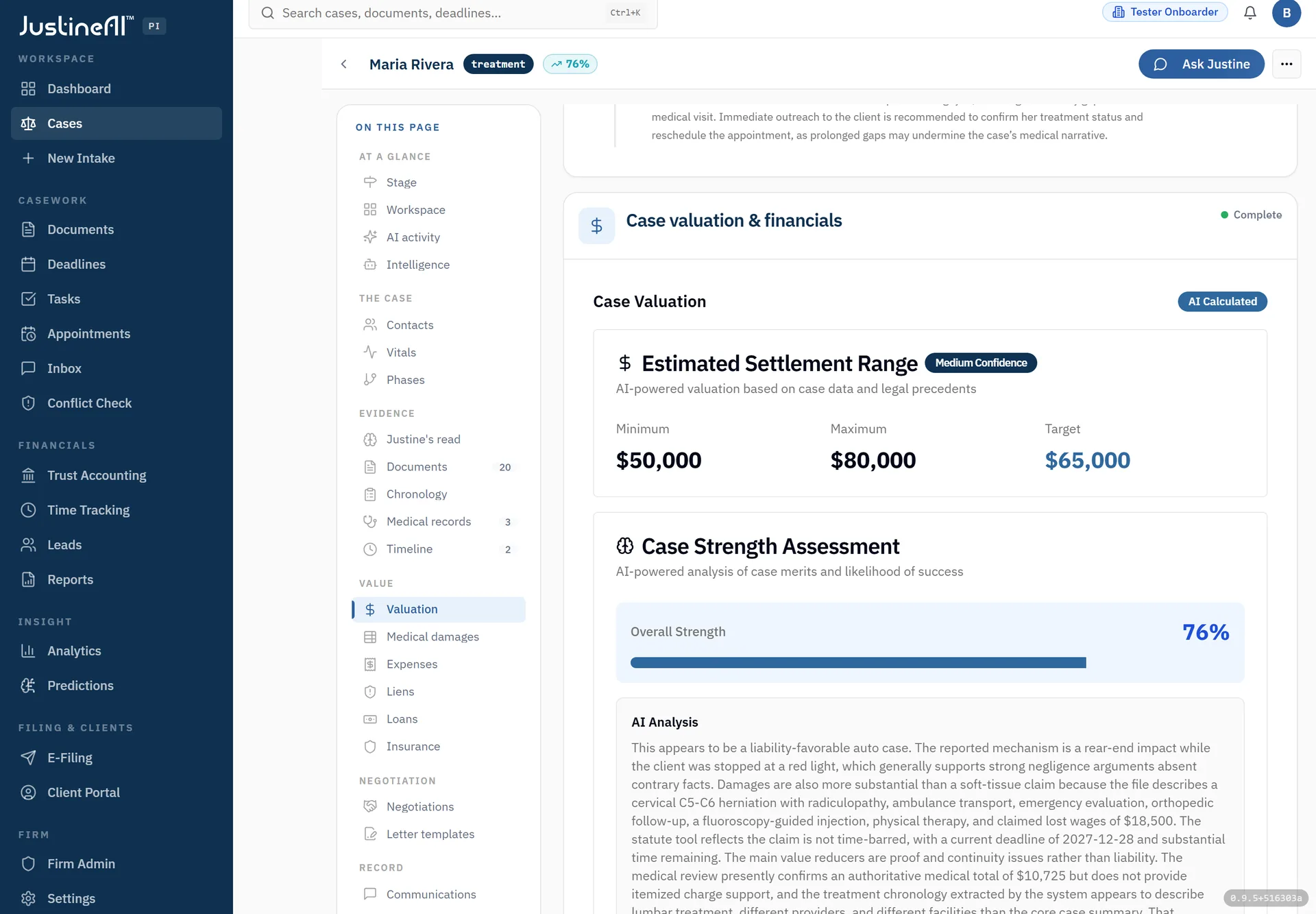
Captured from the working product on a synthetic demonstration matter (SAMPLE_PI_001). No client information. Figures shown are outputs of that demo matter, not customer results.
Built for the people who actually work the file.
One platform across the firm, priced by the seat rather than by the matter. The catalogue is not tier-gated — a support seat and an attorney seat differ in what the person does, not in what Justine will do for them.
Solo and small firms
Start the trial yourself, on your own matters. No integration project and no minimum seat count.
Managing partners
One Digital Employee to supervise instead of a constellation of separately-licensed tools, with the reasoning visible and the refusals published.
Litigation operators
Intake, medical chronology, deadlines, trust accounting and demands on one system, with every finding traced back to the record it came from.
Personal Injury is in market today. Solo and small firms start a trial themselves; mid-size and enterprise onboard sales-assisted.
Priced per seat. AI included.
AI is bundled into every seat — never metered. Demand letters are unlimited at every tier. Every plan starts with a 14-day free trial, no credit card. Annual billing saves roughly two months.
- Justine Core
$149 / mo
per support seat / month
$124/mo billed annually · $1,490 / yr
For the case managers and paralegals who keep matters, records, and deadlines moving.
- The support seat
- Every Justine capability — the seat never changes what Justine can do
- AI bundled — never metered
- 14-day free trial, no credit card
- Justine ProfessionalMost popular
$449 / mo
per attorney seat / month
$374/mo billed annually · $4,490 / yr
The attorney seat — unlimited demand letters, every capability, one price.
- The attorney seat
- Every Justine capability — the seat never changes what Justine can do
- AI bundled — never metered
- 14-day free trial, no credit card
- Justine Firm
Custom
enterprise · custom
For firms of 25+ seats that need custom terms.
- Every Justine capability, on every seat
- Custom MSA + DPA
- Compliance evidence package + named contact
14-day free trial on every plan · No credit card required · Self-serve signup · Annual billing saves roughly two months.
Put one Digital Employee to work across your whole firm.
JustineAI™ PI is live for personal-injury practices in California. Request a 14-day trial — no credit card. AI is bundled, demands are unlimited, and Justine is working matters on day one.
14-day free trial · No credit card required · Self-serve signup
JustineAI™ PI is legal-workflow software, is not a law firm, and its outputs are not legal advice.